You relapsed. Again.
You're here not because you're weak—but because you're human. Shame tells you to disappear. But that just repeats the cycle. So I built this: a 24-hour protocol to restore dignity, dopamine, and direction. No fluff. Just actions that work, grounded in neuroscience.
Get out of your room. Even for 5 minutes. Look at the world again.
It breaks the loop of isolation and restores emotional regulation.
Watch: The Social Brain and Its Superpowers
Dr. Matthew Lieberman explains how the human brain is hardwired to connect—and how isolation can shut down key emotional functions.
Send a kind message. Share something helpful. Give attention.
Helping others shifts your brain out of guilt and into value.
Watch: The Science of Kindness
The Random Acts of Kindness Foundation explains how kindness physically and mentally changes your brain chemistry.
Doesn’t matter what. A dish. Your phone screen. Something.
It proves you can change your state. Builds momentum fast.
Watch: Behavioral Activation
Dr. Ali Mattu explains how simple actions can interrupt depressive spirals and boost forward momentum.
What happened. What you're feeling. What you still want.
Journaling externalizes chaos. It restores clarity and self-trust.
Watch: Expressive Writing and Mental Health
Dr. James Pennebaker discusses how journaling after trauma or setback improves emotion regulation and cognitive clarity.
Get your body moving. Put on headphones. Just walk.
Walking releases BDNF, resets dopamine, and breaks paralysis.
Watch: Movement Changes the Brain
Professor Grant Schofield explains how walking supports neuroplasticity, calm, and long-term resilience after setbacks.
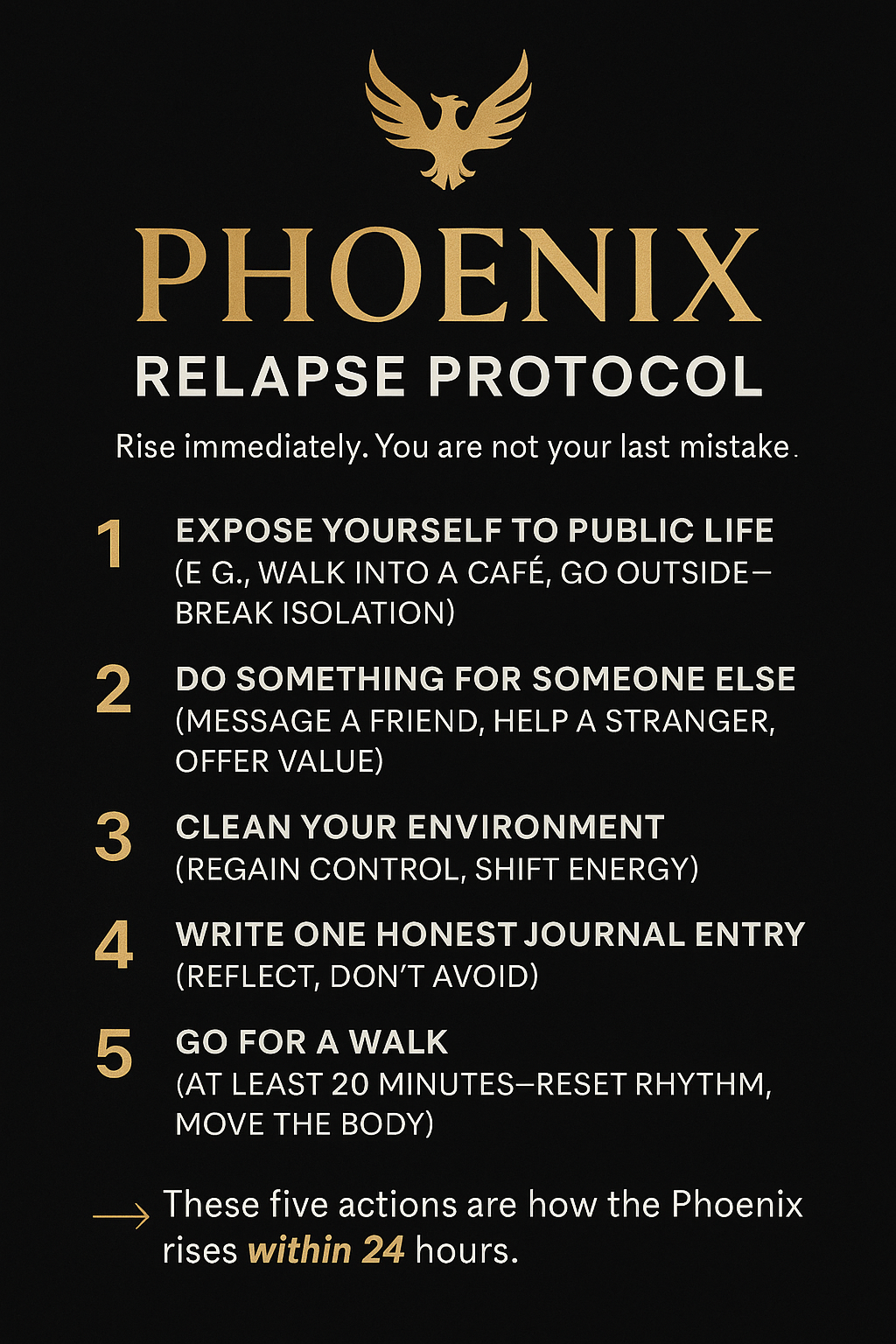
Print this out. Hang it in sight. Use it when you forget who you are.